
The Invisible Evolution from Content to Contempt
What are the most dangerous words in family business? When we ask this question of clients and advisors, we most often hear “conflict,” “lawyer” and “legal documents.” And those guesses can be accurate. Being embroiled in a conflict, asking to speak to a lawyer and reviewing legal documents often foreshadow messy legal battles.
But in our experience, other more frequently used words are, perhaps counterintuitively, even more risky — words like “trust,” “family” and “fair.” These terms often carry an implied meaning that is unique to each family and developed over years of dialogue. But they also often lack formal definitions and remain open to interpretation. And while they can be helpful shorthand to provide stability and build relationships earlier in life (e.g., “I love and trust my family”), they also can unintentionally cause individuals (or even an entire family!) to spiral from content to contempt.
A tale of ambiguity
Take two client cousins we know, John and Sarah (identifying details changed to protect confidentiality). Over the years, one of their favorite sayings was “trust me.” That simple phrase led to countless adventures, from cliff jumping, to remote backpacking trips, to eating foods some would never dream of. They developed such closeness that they could complete each other’s sentences despite spending years apart at colleges on opposite coasts.
But one day, years later when they were both co-leading their family’s $200 million dollar agriculture business, that simple word — “trust” — drove them apart.
Through six years of partnership, John and Sarah had doubled the business revenues and profits. They shared observations about their business at a daily breakfast, they cared for each other when John was going through a divorce and Sarah lost her mother, they tackled hard issues about their leadership styles openly, and they generally showed up for each other.
But gradually those morning breakfasts stopped. The hard conversations became more infrequent. They stopped sharing their personal stories. And it all came to a head over a missed meeting. At that point, the word “trust”, which had connected them for decades, became a weapon instead.
“I don’t trust you anymore,” Sarah had uttered when John missed their fourth leadership breakfast of the month. To John, that was the most hurtful thing that Sarah could say. “What do you mean, you don’t trust me? Especially after all that we’ve been through together” John asked in response, genuinely shocked at the statement. A winding argument ensued, followed by tears, yelling and a cutoff of communication.
Familiarity breeds content and contempt
Having shared language can be an incredible advantage for families in business together. It builds culture and enables individuals to communicate at a speed and effectiveness that others simply can’t comprehend. For John and Sarah, the simple invocation of “trust” was all that was needed to tackle a wild new endeavor.
Yet, shared language in a family enterprise can also be fragile in a specific way, and its erosion is usually invisible until it isn’t. With age and the added complexity of their family enterprise, Sarah had outgrown what “trust” originally represented – and now saw it as being open, reliable and capable at work. But John still viewed trust as he always had – a code word for adventure. And because of this difference in perception, that conversation was deeply hurtful and unproductive.
In our experience, situations like John and Sarah’s are common in a family enterprise when individuals lack language alignment – when both people use the same word, but either don’t understand what their peer means or can’t comprehend how others could see things differently. This is one of the most common challenges in family enterprise. So what causes shared language to erode? Research can help explain.
In a 2011 study published in the Journal of Experimental Social Psychology, Williams College researcher Kenneth Savitsky and University of Chicago researchers Boaz Keysar and Nicholas Epley, found that married couples communicating ambiguous phrases to one another were no more accurate than strangers, yet they were significantly more confident that they had been understood. They called this the “closeness-communication bias.”
The culprit, Epley explained, is what he termed an “illusion of insight”: the closer we are to someone, the more we assume we understand them and the less we bother to check. As Savitsky put it, when we speak to a stranger, we instinctively provide more context because we know we can’t take shared understanding for granted. With people we love, we stop doing that.
Julia Minson from the Harvard Kennedy School reinforces this point in her book, “How to Disagree Better.” She introduces the idea of naïve realism – that people believe that their perceptions and judgments are realistic in some deep, fundamental sense, but fail to realize that other people see the world from a different perspective and thus may interpret it differently. Because of that naïve realism, people often explain disagreement by assuming there is something wrong with their counterpart. And when informing that counterpart fails, they often come to believe that the disagreement is caused by bias or bad intentions.
What’s more, Julia also highlights how we are hardest on people who are close to us than others who are unrelated or more distant. Those in family enterprise will appreciate how she writes, “Ironically, we extend the most tolerance to faraway people we don’t know, while reserving our greatest indignation for neighbors, colleagues and family members.” This highlights a unique challenge that individuals in a family enterprise face.
In either case, family members shortcut, they assume and they try to convince rather than understand. And in a family enterprise, where speed is of the essence, understanding is expected and the stakes of misunderstanding are measured not just in hurt feelings, but in ownership, legacy and the future of the business, that assumption and behavior can be quietly catastrophic. Just as a frog is boiled in water, not in one dramatic moment but through the slow accumulation of heat, so too can families shift from content to contempt through shortcuts, assumptions and words that sound shared but aren’t.
Dangerous words
“Family,” “trust” and “fair” are particularly challenging words for different reasons.
- Family often elicits a strong emotional response because it forces exclusion. Are you talking about your nuclear family, your extended family or a family branch that was bought out years ago? Or perhaps you are distinguishing between bloodline, spouses or owners? Either segmentation is tricky.
- Trust is challenging because it is often used as a catch-all for different issues related to vulnerability, reliability, openness, competence and concern (see A.K. Mishra). And when used generally (as in “I don’t trust you”), it’s hard to understand how to remedy the issue.
- Fairness evokes a deep-seeded need to be treated equally. But what is perceived as fair to one individual who is financially oriented may be seen as unfair to another who focuses more on emotions. Fairness also becomes a possible quagmire when individuals don’t distinguish between equality of opportunities and equality of outcomes.
In addition to family, trust and fairness, other high-risk words we hear include stewardship, strategy, authority and family office. The words alone sound innocuous that they feel easily understood. Yet it is all too easy to have different definitions and therein lies the danger. Imagine a younger sibling saying they have authority to make a business decision. Is that authority familial, professional or something else? And in what sense is it appropriate? Adding fuel to the fire, all of these words carry enormous emotional weight that different family members fill with different meaning without realizing it.
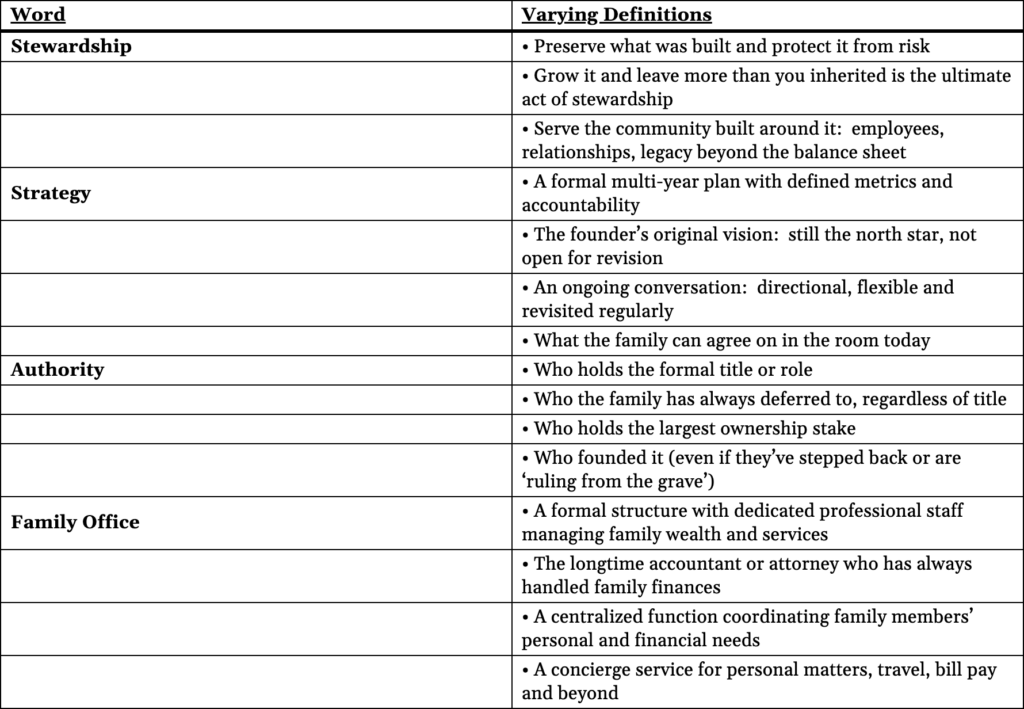
All of these words may seem simple and uncontroversial. But this cognitive dissonance can foster confusion, stall decision making, create unintended bad will or worse.
Issue spotting and course correcting
For many business families, falling into this trap is all too easy. And spotting the challenge is tricky when your language truly is second nature. But there are some signs that language alignment is a key culprit. Two of the most common are a sense that individuals are talking past each other (“you simply don’t understand!”) or a feeling that dialogue is deadlocked (“we’re stuck!”).
So how do families course correct? Simply having awareness that familiarity and language can breed both content and contempt is an important start. And knowing that some words are particularly challenging and require extra vigilance is helpful. Beyond that, the research points to three deceptively simple answers.
First, get curious when you are not certain. Epley’s research draws a critical distinction between taking someone’s perspective (mentally imagining what they might think or feel) and getting it directly through conversation. We assume these are the same thing; they are not. Perspective taking, it turns out, does not reliably increase accuracy. What does reliably increase accuracy is asking the other person what they mean. In a family enterprise, where we are so certain we already know, that simple act of asking can feel unnecessary, even insulting. But the research is clear: the conversation you think you don’t need to have is often the one that matters most. You may be surprised by simplicity of the answer, too, which can be rooted in an innocent psychological emotion (like wanting to feel loved!), but manifests itself very differently.
Second, align on a common definition for tricky words. One definition for trust that we particularly like comes from A.K. Mishra: One person’s willingness to be vulnerable to another based on the expectation that the person is reliable, open, capable and concerned. We find that having that detailed description can make a disagreement around trust much more actionable (e.g., be more vulnerable, open, predictable or caring for another).
Third, when you’re caught in language misalignment, have the conversation you’ve been avoiding. Most families avoid difficult conversations because they expect them to go badly. In a 2024 study, Epley and his colleague James Dungan found that people systematically overestimate how negatively others will respond to direct confrontation and that this miscalibration is precisely what keeps them from having the conversation at all. In reality, the direct conversation tends to go better than anticipated. The dread is louder than the outcome.
Conclusion
John and Sarah loved their business deeply and in their own way. To begin to resolve their challenges, they needed true curiosity, a desire to be specific and a series of real conversations about what they each meant — not about the missed meetings — but about what trust means to each of them and what they could do to rebuild it. They had assumed what each other meant. And as Nicholas Epley’s research and Julia Minson’s ideas remind us, while those assumptions and behaviors can bring us close early in life, they are also exactly where a drift can begin.
Originally published in Family Business Magazine, 9 July 2026.