Spotlight
The Four-Room Model
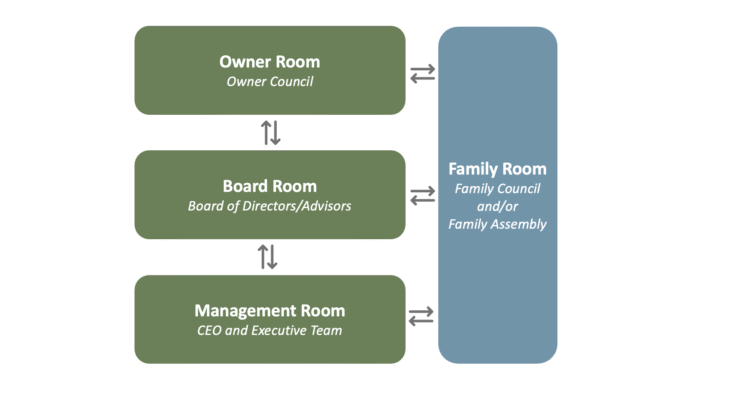
The Four-Room analogy is a simple but dynamic way of rethinking decision-making in family businesses that can be transformative. Think of the governance structure of your family business in four distinct forums: the Owner Room, the Board Room, the Management Room, and the Family Room. By establishing appropriate boundaries between rooms, you can avoid conflict and make better decisions, together.
01.
Introducing the Four-Room Model
Thinking about governance as a “four-room house” is an effective way to organize the people, relationships, and decision-making systems in your family business. This ensures that the rules and boundaries of decision-making are clear to everyone.

02.
The Owner Room
The most important (and often under-developed) room in any family business is the Owner Room. The decisions you make here will shape your business for years– even generations. You must be thoughtful about determining who gets to be in the room and which key decisions are too important to delegate.

03.
The Board Room
Which decisions are appropriate in the Board Room? Business decisions that are so significant that a bad choice could place the company at risk. A well-designed Board Room is a critical link between the Owner and Management Rooms, making sure that executives focus on the Owners’ objectives.

04.
The Management Room
Day-to-day business decisions (such as recommending strategy and operating the business) belong in the Management Room. While Owners may have the right to make any decision about their business, in an effective Four-Room Model, Owners who are not explicitly operators should not be in the Management Room. Rather, they should focus on the handful of important decision reserved for Owners.

05.
The Family Room
The primary purpose of the Family Room is to enhance family unity and develop family talent. A Family Room allows all family members– including spouses and next-generation family members– to build and strengthen bonds, share experiences, and stay connected with the business.

What is the Four-Room Model and how does it help family businesses?
The Four-Room Model is BanyanGlobal’s framework for organizing decision-making in a family business. It distinguishes four distinct forums—the Owner Room, the Board Room, the Management Room, and the Family Room—each with its own appropriate members, decisions, and authority. The Owner Room is where family shareholders align on what they want as owners. The Board Room oversees the business on behalf of owners. The Management Room handles day-to-day operations and strategy. The Family Room focuses on relationships, next-generation development, and family unity. Many family business conflicts arise when decisions made in one room bleed into another—for example, when family dynamics drive ownership decisions, or when management bypasses the board. The Four-Room Model gives families a shared language and structure to prevent and resolve these overlaps.
What is the Owner Room, and why does BanyanGlobal say it is the most important room?
The Owner Room is the forum where all family shareholders come together to exercise their rights and responsibilities as owners. BanyanGlobal considers it the most important—and most often under-developed—room in any family business because the decisions made there shape the direction of the entire enterprise. In the Owner Room, owners determine their collective strategy, set the guardrails for management, define membership and ownership transfer policies, and make decisions too important to delegate. Without a functioning Owner Room, families often find that ownership decisions get made informally, inconsistently, or in conflict—creating governance breakdowns that ripple through the board and management.
How do you prevent governance structures like Owner Councils and boards from becoming 'empty shells'?
Empty governance structures are one of the most common failure modes in family business governance, and BanyanGlobal addresses this explicitly. The key is designing governance bodies for real use, not just formal compliance. This means starting with genuine buy-in from all stakeholders before any structure is formalized; designing meeting agendas and decision processes that create actual value for participants; investing in the behavioral habits and communication norms that make councils productive over time; and providing ongoing support when governance bodies encounter difficult situations for the first time. BanyanGlobal stays involved through implementation—not just design—to ensure that structures become lived practices rather than documents on a shelf.
Get our best ideas, practical guidance, and essential resources sent to your inbox.
Join Our Newsletter