
When “Not Screwing Up” is Not Good Enough
Albina Lysczk left her family meeting feeling deeply unsettled. After several weeks of work, including surveys, interviews, and workshops with her cousins, siblings, parents, aunts, and uncles, she couldn’t shake the feeling that their purpose work for their third-generation consumer products business had been derailed. Frustrated by repeated comments about “not messing up the family business,” Albina felt certain there had to be more, a better reason, a better north star to strive for collectively.
In our work with leading family enterprises, we often hear similar refrains – a focus on not screwing up what the previous generations have built. But that’s not a healthy source of motivation. Nor is it a good enough reason to stay together. In fact, when times get tough, a singular focus on avoiding mistakes and “playing not to lose” can be paralyzing and lead to catastrophic outcomes. Instead, each generation needs to find purpose beyond maintaining the status quo, because doing so can provide stability and guidance when challenges, disruptions, or significant decisions inevitably arise. But what does this really mean?
Purpose is defined as “the reason something is done, created, or exists, or the intended result or use of something,” according to the Merriam Webster dictionary. In real life, purpose manifests itself in many different ways, from Maslow’s hierarchy and self-actualization, to Frankl and meaning, to Buddhism and being present, to the Japanese concept of Ikigai and finding the intersection of what someone loves, what they are good at, what their world needs, and what they can be paid for.
While each of these concepts can be helpful in different situations, they are not as effective when applied to family enterprise owners because they fail to account for the family quotient, which adds a significant layer of history and relationship complexity. What owners really need is specificity, a language and understanding around purpose that is relevant to their circumstances. Without this, purpose can become at best a distraction and at worst a source of tension. One of our clients reinforced this notion when they said during a meeting “Purpose, purpose, purpose. If we don’t know what we are talking about, then this meeting is over!”
So how do the most effective owners start a real conversation about purpose – one that goes deeper and builds a stronger foundation for the future? Here’s how to start.
A question of value and language
In family business, one of the most important things owners can do is to articulate why they continue to own their business together – their purpose. While many owners gloss over this topic, often skipping over whether they should continue to own the asset together let alone why, the most effective ones know that they must answer what we call “question zero.”
Many times, owners do attempt to address this question. But all too often, we hear about purpose conversations that fail to yield a meaningful or durable outcome. The owners may focus on financials – “because owning together gives us scale and access to better opportunities” – or on flowery but non-specific language – “to continue the legacy of those before us.” In our experience, statements like these fail to provide guidance and direction when business goes south or owners have disagreements; they don’t go deep enough. And many times, they lack depth because owners don’t have a common language or frame that allows them to reflect and move beyond the shortcomings of their initial instincts. But that doesn’t have to be the case.
In our experience, owners who have the most meaningful conversations think about and differentiate purpose along two dimensions, energy and focus. On the energy dimension, purpose can be either positive or avoidant. And on the focus dimension it can be either internal or external. Let’s examine each of the possible types of purpose along those dimensions:
- Obligatory: If you have avoidant energy and internal focus, we call this obligatory purpose. Obligatory purpose manifests itself most often with rising generation family members who, like Albina’s cousin, are focused on not tarnishing the legacy that is being given to them. While focusing purpose within this quadrant can be helpful to drive action, it can also become an unhelpful burden that saps energy and leads to paralysis or mistakes.
- Motivational: Other individuals find purpose by focusing internally and positively – often taking the shape of personal growth and achievement. Just like serial entrepreneurs or autodidacts who have deep intrinsic motivation and find pleasure in learning for learning’s sake, so too can owners find what we call their motivational purpose.
- Identity: Alternatively, some owners we work with find purpose with a focus on protecting or avoiding loss of what their assets do for them in the outside world – an avoidant and external focus. This most often manifests itself through a desire to not lose status, power, or money in the business or community, each of which can be strong drivers for collective and individual action.
- Aspirational: Lastly, some owners find purpose with an external and positive focus. These are individuals who seek to change the world through their collective ownership. Whether it is supporting customers, providers, employees, the communities within which they live and operate, or other stakeholders, their primary focus is on leaving the world a better place than they found it.
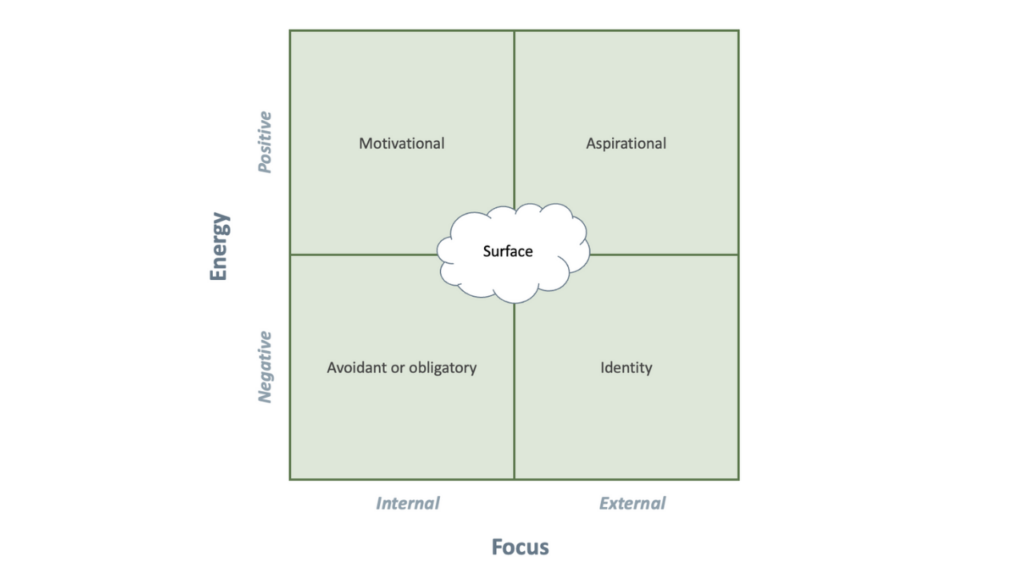
De-averaging purpose into these component parts enables individuals to reflect more deeply along each dimension. Examining each dimension of purpose individually can surface what individuals really want for themselves and their communities. Equipped with a better sense of who they are and what they want, individuals can then more effectively engage in collective conversations about their “question zero,” which often yields more meaningful, practical, and effective outcomes on purpose that move beyond merely accepting the past.
Common pitfalls of purpose
Having a common definition and a sense of self is just the start. With or without those, many families still fall victim to several common purpose traps. These pitfalls are easily avoidable if you know how to look out for them. So, what should you scan for and invest to avoid?
- Lack of purpose: The most common and obvious purpose pitfall is not tackling the question to begin with. Here, the ownership group fails to engage in the conversation, which can create tension, confusion, and misalignment, often when some of the most difficult questions must be addressed. Lacking clear glue and guidance, these groups suffer unnecessarily. If you find yourself in this situation, a simple solution is to reflect personally and then ease into the conversation with your family, however uncomfortable it may be.
- Surface purpose: Another pitfall we see often is surface purpose. Much like “staying together enables scale and opportunities,” these purposes lack depth and tend to break down in the face of adversity or ambiguity. In addition, surface purpose tends to become less effective as the family grows larger more diverse, when depth matters more. To break out of surface purpose, we often see owner groups test their thinking against hypotheticals entangled with identity or emotional challenges.
- Purpose imbalance: Other owner groups succumb to purpose imbalance – overweighting the reason they stay together to one quadrant or another. This may manifest like it did with Albina, focusing deeply on avoiding mistakes. But it also can occur when owners over-index to other quadrants – which become harder to build alignment in the broader owner group. In this situation, most families find it useful to chart their purpose in the matrix to observe visually where they stand, and to discuss whether and how to achieve better balance.
- Purpose overhang: The last common pitfall we see is purpose overhang. This occurs when a rising generation accepts as true, without examination, the purpose of a previous generation. While this approach offers the path of least resistance, one that is more easily supported by the previous generation, it is also often less durable largely because the rising generation hasn’t done the work to align as a cohort who exists in a different world, with a different family, and a different business. To avoid this pitfall, one of our clients said it best when they suggested that “every generation must choose.”
Simply understanding the common pitfalls can ensure that you are having the right discussions with your group to align on purpose and build a strong foundation for the future.
Conclusion
In Albina’s case, once they realized they were stuck, she reconvened her fellow owners and introduced the different types of purposes and their potential pitfalls. After several conversations and an in-person workshop during which they charted their responses, the group recognized their purpose imbalance. To unlock the conversation, they went back to their history, talked about key inflection points, decisions, and the reasons behind both. They also sought out opinions from long-tenured employees, customers, and stakeholders and held series of deep conversations about both their collective histories and their aspirations. From those conversations, they built out their purpose with a focus less on avoiding mistakes and more on what they could build together and how they could positively influence their stakeholders – by supporting each other, learning together, investing in their community, and improving society through their business and philanthropic contributions.
Not wanting to let that foundation atrophy, they now start every meeting with a reflection on how they individually contribute to their purpose, how the business has contributed to it, and what it means to their employees and customers who experience it. They also used their purpose work to inform their owner strategy – what they hope to achieve, why, and how they will measure success. And recognizing that they will need to evolve it as the next cohort of owners comes of age, they have built into their priorities a plan to discuss purpose again in the next few years.
Purpose can be a squishy subject for family business owners, one that is uncomfortable and difficult to process, discuss, and gain consensus on. But it doesn’t have to be that way. Finding a common language to describe the different types of purpose can help those groups to find better alignment and avoid the common pitfalls that many families experience. When’s the last time you and your fellow owners had a meaningful discussion about purpose? This language can help you go deeper and build a stronger foundation for years to come.